
July 13, 2026
Learn how dental crowns protect damaged teeth, how dental bridges replace missing teeth, and how your dentist determines which option is right for your smile.
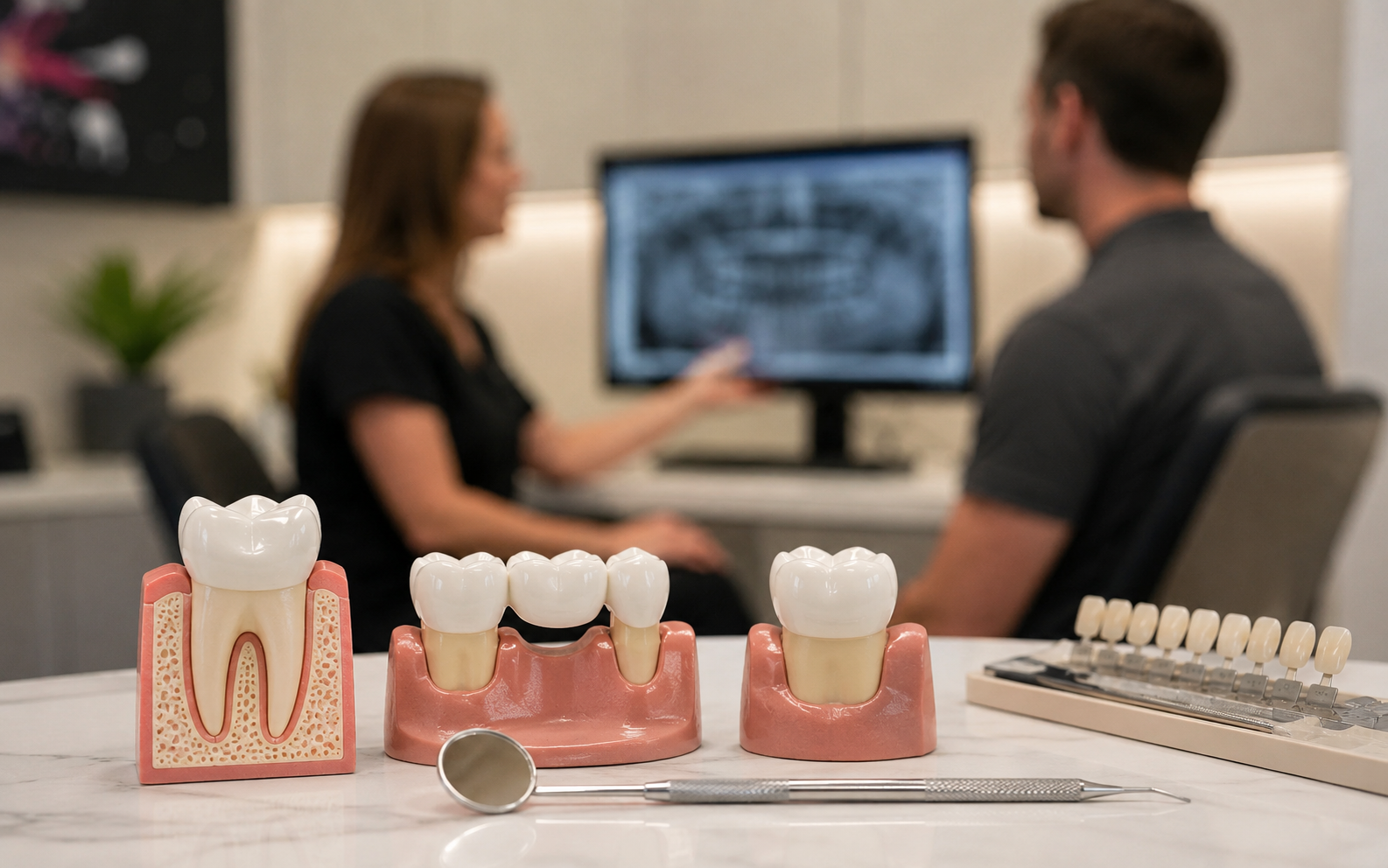
A dental crown and a dental bridge solve different problems. A crown covers and protects a damaged tooth that is still present, while a bridge replaces one or more missing teeth.
If your natural tooth can be preserved, your dentist may recommend a crown. If the tooth is already missing or cannot be saved, a bridge may be one of the options used to restore the space.
Although crowns and bridges are both common restorative dental treatments, choosing between them depends on more than appearance. Your dentist must consider the health of the tooth, the condition of the surrounding teeth and gums, your bite, and your long-term oral health.
At Groovy Dental in Austin, TX, Drs. Alyssa and Trenton Dawson help patients understand their restorative options without pressure or confusion. Whether you have a cracked tooth, a missing tooth, an old restoration, or discomfort when chewing, the first step is determining what is happening and which treatment offers the best combination of strength, comfort, function, and appearance.
Dental Crown vs. Dental Bridge: Quick Comparison
A dental crown and a dental bridge are both used to restore your smile, but they solve different problems. A crown covers and protects a damaged, weakened, cracked, or heavily restored tooth that is still present. It usually treats one tooth and may be supported by the natural tooth or a dental implant. A bridge is used when one or more teeth are missing. It fills the open space with a replacement tooth that is supported by nearby teeth or dental implants. Depending on your situation, alternatives to a crown may include a filling, onlay, root canal treatment, or extraction, while alternatives to a bridge may include a dental implant or removable partial denture.
The easiest way to remember the difference is: a crown restores a tooth that is still there, while a bridge replaces a tooth that is missing.
What Is a Dental Crown?
A dental crown is a custom-made restoration that covers the visible portion of an existing tooth. It is sometimes described as a cap because it fits over the prepared tooth and restores its shape, strength, size, and appearance.
Crowns are commonly recommended when a tooth has more damage than a routine filling can reliably repair.
A dental crown may be used to:
- Protect a cracked or weakened tooth
- Restore a broken or severely worn tooth
- Repair a tooth with a large cavity
- Cover a tooth with a large or failing filling
- Protect a tooth after root canal treatment
- Improve the shape or appearance of a damaged tooth
- Complete a dental implant
- Help support a traditional dental bridge
Crowns are designed to blend with the surrounding teeth while also providing enough strength for everyday biting and chewing.
When Might You Need a Dental Crown?
A dentist may recommend a crown when there is still enough healthy tooth structure to preserve the natural tooth, but the tooth needs more protection than a filling alone can provide.
You have a cracked tooth
A cracked tooth may cause pain when biting, sensitivity to hot or cold temperatures, or intermittent discomfort that is difficult to pinpoint.
If the crack has not extended too far into the tooth or root, a crown may help stabilize and protect the remaining tooth structure. The appropriate treatment depends on the location and depth of the crack.
You have a large cavity
A small cavity may be repaired with a filling. However, if decay affects a significant portion of the tooth, there may not be enough strong enamel remaining to support a large filling.
A crown can cover the tooth and help distribute chewing pressure more evenly.
You have a large or failing filling
Older fillings can wear down, loosen, crack, or allow new decay to develop around their edges. If a tooth has already lost a large amount of natural structure, replacing the filling with another filling may not offer enough protection.
A crown may provide a stronger and more predictable restoration.
You recently had root canal treatment
Root canal therapy removes infected or damaged tissue from inside a tooth. Depending on the tooth’s location and remaining structure, a crown may be recommended afterward to reduce the risk of fracture and restore normal function.
Your tooth is severely worn down
Teeth may become worn from grinding, clenching, bite pressure, acid exposure, or years of use. When wear is significant, a crown may help restore the tooth’s height, shape, and chewing surface.
Your tooth is broken or misshapen
Crowns may also be used when a tooth has lost a significant portion of its structure or when its shape, color, or appearance cannot be improved predictably with a more conservative treatment.
What Is a Dental Bridge?
A dental bridge is a fixed restoration used to replace one or more missing teeth. The replacement tooth fills the open space and is supported by neighboring natural teeth, crowns, or dental implants.
The artificial tooth that fills the gap is called a pontic. The supporting teeth or implants hold the restoration securely in place.
Unlike a removable partial denture, a fixed bridge stays in your mouth and is not taken out for routine cleaning.
A dental bridge may help:
- Fill a visible gap in your smile
- Restore chewing function
- Improve speech affected by missing teeth
- Support a more balanced bite
- Reduce the risk of nearby teeth shifting
- Restore confidence when smiling
- Provide a fixed alternative to a removable appliance
When Might You Need a Dental Bridge?
A bridge may be considered when a tooth has already been lost, has been removed, or cannot be restored.
You have a missing tooth
The most common reason for a bridge is to replace a permanent tooth that is no longer present.
The missing tooth may have been lost because of decay, gum disease, an injury, infection, or a necessary extraction.
You are having difficulty chewing
A missing back tooth can make it uncomfortable to chew on one side of the mouth. Over time, you may begin relying more heavily on the opposite side, which can place uneven pressure on the remaining teeth.
Replacing the missing tooth may help restore a more balanced chewing pattern.
Nearby teeth are beginning to shift
Teeth naturally help support one another. When a permanent tooth is lost, nearby teeth may gradually move or tilt toward the open space.
This movement can affect alignment, create difficult-to-clean areas, and change the way your upper and lower teeth meet.
You want a fixed tooth-replacement option
Some patients prefer a restoration that stays securely in place rather than a removable partial denture.
A bridge may provide a fixed solution, depending on the health and position of the surrounding teeth, gums, and bone.
What Is the Main Difference Between a Crown and a Bridge?
The primary difference is the condition of the natural tooth.
A crown is used when the tooth is still present and can be restored. A bridge is used when a tooth is missing and the space needs to be filled.
For example:
- If you have a cracked molar that can still be saved, a crown may protect it.
- If the molar has already been removed, a bridge may replace it.
- If a tooth cannot be saved, the dentist may discuss extraction followed by a bridge, implant, or another tooth-replacement option.
Crowns and bridges can also work together. In a traditional bridge, crowns may be placed on the teeth on either side of the missing-tooth space. Those crowns support the artificial tooth positioned between them.
How Dr. Dawson Determines Whether You Need a Crown or Bridge
There is no single treatment that is best for every patient. Before recommending a crown, bridge, implant, or another option, your dentist must evaluate the full situation.
At Groovy Dental, the treatment-planning process may include a clinical examination, digital imaging, photographs, bite evaluation, and a conversation about your symptoms and goals.
Factors that may influence the recommendation include:
- Whether the natural tooth is still present
- How much healthy tooth structure remains
- The location and depth of decay
- Whether the tooth is cracked
- Whether infection is present
- Whether root canal therapy is needed
- The health of neighboring teeth
- Gum and bone health
- Your bite and chewing pressure
- Tooth grinding or clenching
- The location of the tooth in your smile
- Your cosmetic preferences
- Your budget and insurance benefits
- Whether a dental implant is appropriate
The goal is not simply to cover a tooth or fill a space. The goal is to choose a restoration that makes sense for your oral health and provides a dependable long-term result.
Three Common Crown and Bridge Scenarios
Scenario 1: A cracked tooth is still present
A patient has a cracked molar that hurts when chewing. The tooth still has enough healthy structure to be preserved.
After evaluating the crack and the inside of the tooth, the dentist may recommend a crown to stabilize the tooth and restore comfortable chewing. If the nerve is affected, root canal treatment may also be needed.
Scenario 2: A tooth has already been removed
A patient has an open space after losing a tooth. The teeth next to the space are strong enough to support a traditional bridge.
The dentist may recommend preparing the neighboring teeth for crowns and connecting them to a replacement tooth that fills the gap.
Scenario 3: The neighboring teeth are healthy
A patient is missing one tooth, but the teeth on each side of the space are healthy and do not otherwise need crowns.
In this situation, the dentist may also discuss a dental implant. An implant may replace the missing tooth without requiring the neighboring teeth to support a traditional bridge.
Each scenario requires an individual evaluation. What works well for one patient may not be the best choice for another.
What Happens During Dental Crown Treatment?
The crown process may vary depending on the condition of the tooth and the technology being used.
In general, treatment includes the following steps:
Examination and diagnosis
Your dentist evaluates the tooth, surrounding gums, bite, and any available X-rays. If decay or infection is present, those issues must be addressed before the final crown is placed.
Preparing the tooth
The tooth is numbed and carefully shaped to create space for the crown. Damaged or decayed portions are removed, and the remaining structure may be rebuilt if necessary.
Capturing the tooth’s shape
An impression or digital scan is taken to record the prepared tooth, neighboring teeth, and bite.
Temporary restoration
A temporary crown may be placed while the permanent restoration is being created. The temporary crown protects the tooth, but it may require extra care with hard or sticky foods.
Final placement
At the final visit, the dentist checks the crown’s fit, shape, bite, and appearance. Once everything is satisfactory, the crown is secured in place.
What Happens During Dental Bridge Treatment?
Bridge treatment also begins with an examination and treatment plan.
For a traditional dental bridge, the process may include:
Evaluating the missing-tooth space
The dentist examines the space, neighboring teeth, gums, bone support, and bite. This helps determine whether the surrounding teeth can support a bridge.
Preparing the supporting teeth
The teeth next to the gap may be reshaped for crowns. These crowns will serve as anchors for the replacement tooth.
Taking an impression or digital scan
The dentist captures the shape and position of the prepared teeth and the open space.
Placing a temporary bridge
A temporary restoration may be used while the permanent bridge is being made.
Fitting the permanent bridge
The dentist evaluates the bridge’s fit, appearance, bite, and comfort before securing it.
The exact process can differ if the bridge is supported by dental implants rather than natural teeth.
Crown vs. Bridge: Advantages and Considerations
Potential advantages of a dental crown
- Preserves an existing natural tooth
- Restores strength and shape
- Protects weakened tooth structure
- Can improve the tooth’s appearance
- May restore comfortable chewing
- Can complete a dental implant
Considerations with a dental crown
- The natural tooth must be reshaped
- The restoration may eventually need replacement
- Decay can still develop around or underneath the crown
- Grinding or clenching can damage the crown
- Root canal treatment may still be needed in some cases
Potential advantages of a dental bridge
- Replaces one or more missing teeth
- Stays fixed in the mouth
- Restores the appearance of the smile
- Helps improve chewing function
- May be completed faster than some implant treatments
- Can help maintain the position of surrounding teeth
Considerations with a dental bridge
- A traditional bridge requires support from neighboring teeth
- Supporting teeth may need to be reshaped
- Cleaning underneath the bridge requires additional attention
- Problems with a supporting tooth may affect the entire bridge
- An implant may be a more appropriate option in certain situations
Dental Crown vs. Bridge vs. Dental Implant
A dental implant is another option for replacing a missing tooth.
The implant itself is placed in the jawbone and functions as an artificial tooth root. After the area heals, a custom crown is attached to create the visible replacement tooth.
A crown may be recommended when:
- The natural tooth is still present
- The tooth can be preserved
- Additional protection is needed
A bridge may be recommended when:
- One or more teeth are missing
- Nearby teeth can support the restoration
- A fixed replacement is desired
- Implant treatment is not preferred or appropriate
An implant may be recommended when:
- A tooth is missing
- There is adequate bone and healthy tissue
- The patient is a suitable surgical candidate
- Preserving neighboring teeth is a priority
- The patient is prepared for a longer treatment process
Implants, bridges, and removable dentures each have advantages and limitations. Your dentist can explain how they compare based on your health, timeline, goals, and budget.
How Long Do Dental Crowns and Bridges Last?
Crowns and bridges are designed to be durable, but no dental restoration is guaranteed to last forever.
Their longevity may depend on:
- Brushing and flossing habits
- Gum health
- Regular dental examinations
- The condition of the supporting teeth
- Grinding or clenching
- Bite pressure
- Diet
- The location of the restoration
- Accidents or injuries
- Tobacco use
- The restorative material
Some restorations last for many years, while others may require repair or replacement sooner. Routine dental visits allow your dentist to check the restoration and look for early signs of wear, leakage, decay, or gum problems.
How Do You Care for a Dental Crown?
A crowned tooth still requires daily care because the natural tooth remains underneath the restoration.
To care for a crown:
- Brush twice daily with fluoride toothpaste
- Floss around the crown every day
- Attend routine dental cleanings and exams
- Avoid chewing ice or hard nonfood objects
- Tell your dentist if the crown feels loose
- Ask about a nightguard if you grind your teeth
- Seek care if you develop pain, sensitivity, or swelling
Pay particular attention to the area where the crown meets the gumline, since plaque can collect around the edge.
How Do You Clean Under a Dental Bridge?
A traditional bridge is connected, so regular floss cannot always pass directly between the artificial tooth and the gum.
Your dental team may recommend:
- Floss threaders
- Interdental brushes
- A water flosser
- Specialized bridge floss
- Regular professional cleanings
Cleaning under the replacement tooth and around the supporting teeth helps reduce plaque buildup, gum inflammation, decay, and bad breath.
Is Getting a Crown or Bridge Painful?
The treatment area is typically numbed before the teeth are prepared. You may feel pressure or movement during the procedure, but the goal is to keep you comfortable.
After treatment, some patients experience temporary sensitivity, gum tenderness, or mild soreness. These symptoms often improve as the area settles.
Tell your dentist if you:
- Feel anxious about dental treatment
- Have had difficulty becoming numb
- Have a strong gag reflex
- Need extensive treatment
- Are concerned about discomfort
Groovy Dental offers comfort-focused care and sedation options for qualifying patients who need additional help relaxing during treatment.
How Much Does a Crown or Bridge Cost?
The cost of treatment depends on your individual needs.
Factors that may affect the cost include:
- The number of teeth involved
- The material used
- Whether a buildup is needed
- Whether root canal treatment is required
- The type of bridge
- Whether natural teeth or implants provide support
- Additional imaging or preparatory treatment
- Dental insurance benefits
- Laboratory requirements
A bridge frequently involves several connected units, so its total cost may be higher than the cost of one crown. However, treatment plans differ significantly from patient to patient.
After your examination, the dental team can provide a personalized estimate and review your insurance, payment, or membership options.
What Happens If You Wait Too Long?
Dental problems do not always cause constant pain. However, delaying treatment can allow damage to progress.
A weakened tooth may develop a deeper crack. Decay may spread closer to the nerve. An infection may worsen. A tooth that could once have been restored with a crown may eventually require root canal therapy or extraction.
Leaving a missing-tooth space untreated may also allow nearby teeth to shift, affect chewing, or change the bite.
Contact a dentist promptly if you experience:
- Persistent tooth pain
- Swelling
- Pain when biting
- A cracked or broken tooth
- A loose crown or bridge
- A lost restoration
- A bad taste near a tooth
- Fever associated with dental pain
- Facial swelling
- Dental trauma
Groovy Dental offers same-day emergency dental care and welcomes walk-ins based on availability.
Dental Crowns and Bridges in Austin, TX
Groovy Dental provides restorative dental care for patients in Austin and surrounding North Austin communities.
Patients visit the practice from areas including:
- Cedar Park
- Round Rock
- Pflugerville
- Leander
- Georgetown
- Wells Branch
- Jollyville
- McNeil
- Brushy Creek
Whether you have a damaged tooth, missing tooth, loose crown, failing bridge, or unexplained tooth pain, Drs. Alyssa and Trenton Dawson can evaluate the area and explain which treatment options may be appropriate.
Frequently Asked Questions About Crowns and Bridges
Is a crown or bridge better for a missing tooth?
A crown alone does not normally replace a missing tooth unless it is attached to a dental implant. A bridge is specifically designed to replace one or more missing teeth. Your dentist may also discuss an implant or removable partial denture.
Can a dental crown replace a missing tooth?
A traditional crown covers an existing tooth. However, an implant crown can replace the visible portion of a missing tooth when it is attached to a dental implant.
Can a bridge replace more than one tooth?
Yes. Certain bridges can replace multiple adjacent teeth. The number of teeth that can be replaced depends on the size of the space and the health of the supporting teeth, implants, gums, and bone.
Can a cracked tooth be saved with a crown?
Some cracked teeth can be protected with a crown, but treatment depends on the depth and location of the crack. If the crack extends too far below the gumline or into the root, the tooth may not be restorable.
Does a dental bridge damage nearby teeth?
A traditional bridge requires the supporting teeth to be reshaped for crowns. This is not necessarily harmful when the teeth are appropriate bridge supports, but it is an important treatment consideration. A dental implant may be discussed if preserving untouched neighboring teeth is a priority.
Can you get a bridge if the neighboring teeth already have crowns?
Possibly. Your dentist must examine the existing crowns, underlying teeth, bite, and overall health of the supporting structures before making a recommendation.
Can a bridge be attached to dental implants?
Yes. Dental implants can support certain types of bridges, particularly when multiple teeth are missing. The treatment plan depends on the number and location of missing teeth and the available bone.
How long does it take to get a crown or bridge?
The timeline varies based on the type of restoration, condition of the teeth, laboratory process, and whether additional treatment is needed. Many crowns and bridges involve a preparation visit followed by a separate placement visit.
Can I eat normally with a crown or bridge?
Once the final restoration is placed and the area has settled, most patients can return to a normal diet. Avoid chewing excessively hard objects, and follow any instructions provided by your dentist.
How do I know whether I need a crown, bridge, or implant?
A dental examination is necessary to determine whether the tooth can be preserved and whether the surrounding teeth, gums, and bone can support the treatment. Your dentist can then compare the appropriate options with you.
Restore Your Smile With Groovy Dental
You do not have to decide between a dental crown, bridge, or implant on your own.
At Groovy Dental, Drs. Alyssa and Trenton Dawson can examine the affected area, determine whether your natural tooth can be preserved, and explain the advantages and considerations of each appropriate treatment option.
Whether you need to protect a damaged tooth or replace one that is missing, our Austin dental team is here to make the process clear, comfortable, and—of course—a little more groovy.
Contact Groovy Dental today to schedule your restorative dental evaluation.